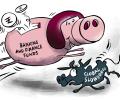
Invest only if you wish to go overweight on the sector.
'When a company goes into insolvency, by definition it means that existing shareholders have been wiped out.'
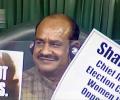
The Opposition intensified its noisy protests in Lok Sabha on Wednesday over Pegasus snooping, farm laws and other issues with some unruly members even hurling papers and torn placards in the House, but the government went ahead with its legislative agenda and three bills were passed amid the din.

The National Company Law Tribunal (NCLT) has approved the resolution plan of Twin Star Technologies -- a promoter entity of the Vedanta Resources group -- for the Videocon group. But it has pointed out that the successful resolution applicant is "paying almost nothing" as the amount offered is only 4.15 per cent of total outstanding claim. It noted the hair cut for all the creditors is 95.85 per cent and suggested to both committee of creditors (CoC) and the successful applicant an increase in the payout.

Of the Rs 4,405 crore unpaid debt of 12 companies, more than half was locked in just one Mumbai-based real estate company, Kohinoor CTNL Infrastructure.

SBI and other public sector banks have decided to lend Rs 4,000 crore to Patanjali Ayurved for the acquisition of Ruchi Soya, which was facing bankruptcy proceedings under the Insolvency and Bankruptcy Code. The money lent by banks will help the PSBs to settle their exposure to Ruchi Soya with a haircut of 65 per cent. Banks led by SBI and others had earlier made claims of over Rs 12,146 crore against Ruchi Soya after the company failed to repay its loans.

The new Chief Economic Advisor Krishnamurthy Subramanian believes that more than unemployment, it is the quality of employment which needs to be focused on. In an interview with Arup Roychoudhury and Indivjal Dhasmana, Subramanian said that controlling inflation was the Modi government's biggest achievement.
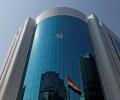
Maximum promoter holding to be eligible for reclassification to be raised from 10% to 15%; waiting time to be brought down to one month from three.

Chief Economic Adviser K V Subramanian on Monday said India is likely to post current account surplus in the current financial year as there is moderation in import due to under heating of the economy triggered by the COVID-19 crisis. This crisis is different from what the world witnessed during the taper tantrum, he said while addressing a virtual conference organised by industry body CII. Taper tantrum phenomenon refers to the 2013 collective reactionary response that triggered a spike in US treasury yields, after investors learned that the US Fed was slowly putting brakes on its quantitative easing (QE) program.

The system envisaged under the FRDI Bill, if implemented properly, would help improve the efficiency of capital allocation without harming consumers, and without risking the stability of financial firms, says Ajay Shah.

With 600-700 new NPA cases getting admitted into NCLT every month, the demand for resolution professionals is on the rise with their number more than doubling in less than a year.

While passing the scrutiny of courts is a tough challenge, with eight proposed amendments to the insolvency law, the government has sought to turn the focus back on at least some of the functions of the bankruptcy law.
Nifty PSU bank index dropped nearly 2%

After taking action against 226,000 shell companies last year, the ministry of corporate affairs has now zeroed in on a fresh batch of suspected shell companies.
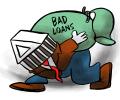
'The concern that the bad bank may create a moral hazard for the system is extremely valid.'

Noted banker Uday Kotak said the country's financial system is currently in a Darwinian mode as only the fittest lenders are able to survive. Kotak also said that historically, whenever there has been a problem with a private sector lender, it has been merged with a state-run bank.

Even existing cases might come under the proposed law, including those of Vijay Mallya, Nirav Modi and Mehul Choski. But, the law would not cover earlier cases.
The statement, issued after the 2-day meeting of the 6-member Monetary Policy Committee of the Reserve Bank of India, also said that recapitalisation of public sector banks along with resolution of stressed assets under the Insolvency and Bankruptcy Code (IBC) will create demand for fresh investments.

The haircut for major banks stands at 52 per cent, if the dues of Jaypee Infrastructure, Lanco Infrastructure and Era Infrastructure are kept out of the calculation.

Since the bankcuptcy law came into effect from December 2016, with every quarter, the recovery rate has progressively been going down, notes Tamal Bandyopadhyay.
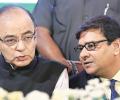
'I suspect the recovery that the banks are going to get out of this IBC is not going to be more than 30 per cent.' 'If you leave the steel industry aside, the recovery rates are not looking very, very healthy,' Jairam Ramesh tells the Rajya Sabha.

Listing the series of reforms which led to the upgrade, he said while demonetisation took the economy towards greater formalisation and digitisation, use of Aadhaar ensured targeted delivery of government benefits.

RBI would like to work on examining the regulatory framework for the voluntary withdrawal by the entrepreneur.

The recent amendments to the IBC practically barred promoters from re-acquiring their own assets, leaving only a small window to convert their non- performing assets into standard assets by paying the overdues.

'What do the moves towards protectionism suggest?' 'That we do not have Aatmavishwas.' 'If you have self-confidence, confidence in your ability to compete with the best in the world, why do you need protectionism?'
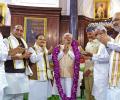
If the concerns over risking political capital are overcome, the long-term gains for the Indian economy will be immense, asserts A K Bhattacharya.
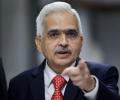
Reserve Bank Governor Shaktikanta Das on Wednesday said underlying economic activity in India continues to be strong, but external factors will cause some "dent" to the economy. Speaking at the BFSI Insight Summit 2022 organised by Business Standard, Das said the RBI tracks 70 fast moving indicators and most of them are in the "green box". It is the external sector, mired by a fear of recession or clear visibility about slowing growth in a large part of the world, where the challenges lie, he said, adding that the impact of external demand will "dent" the economy.

'The quick fixes have failed; there is now no alternative to deeper reforms,' says Ajay Shah.
About 50 per cent of the accounts that availed of the EMI moratorium amid the pandemic, which made things worse in an already slowing economy, are expected to be restructured, and of these accounts that would undergo restructuring, one-third, or Rs 6-9 trillion, could turn into NPAs.

For the second year in a row, India has been recognised as the fifth-best performing nation in reforming the business environment. However, in the two categories that the government was banking on most - "Paying Taxes" and "Resolving Insolvency" - landmark reforms that were expected to yield better results have had the opposite effect. Under the circumstances should the country celebrate already or are there any reasons for worry, wonders Subhayan Chakraborty.
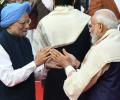
False and acrimonious debates such as Modi versus Manmohan might allow for victories that are political and partisan. But the real loser is the nation, India and Bharat, notes Arvind Subramanian, former chief economic advisor to the Modi government in its first term.

"The fourth quarter results of GDP data showed a phenomenal 7.7 percent growth rate and has established India firmly as the fastest growing global economy. This trend, according to experts, is likely to continue for the next few years," Jaitley said in a Facebook post.
The code says the process is intended to balance the interests of all stakeholders and the resolution plan is also required to make a statement as to how it has dealt with these interests.

Bankruptcy proceedings are going at a slower pace than what the bankers had envisaged and many cases have gone beyond the 270-day timeline set under the IBC mainly because of litigation.

The remarks by the CJI came against the backdrop of the recent remarks by Vice President Jagdeep Dhankhar who questioned the landmark 1973 Kesavananda Bharati case verdict that gave the basic structure doctrine.

The government on Tuesday extended the deadline for filing income tax and GST returns, raised the threshold of default that could trigger insolvency of a company, and waived charges on cash withdrawals from ATMs of other banks as a precursor to a broader stimulus package for the economy distressed by the coronavirus outbreak.

The closure of BPSL would add about three million tonnes capacity to JSW Steel's existing 18 million tonnes.

India's goal of self-reliance has been paramount in the policy and practice of the country. The COVID-19 crisis gave us lessons on how to speed up efforts in that direction, he said.

RBI deputy governor N S Vishwanathan has said the new framework was in line with the Insolvency and Bankruptcy Code guidelines.

The National Company Law Tribunal on Tuesday approved the Jalan-Kalrock Consortium's resolution plan for the bankrupt Jet Airways.
